
The former director of writing and humanities in the Carver College of Medicine aims to rethink the role of literature and storytelling in a divided world.
July 1, 2026
Written by: Leslie Revaux
As the International Writing Program (IWP) approaches its seventh decade, new director Cate Dicharry sees opportunity in the program’s next chapter. Since she stepped into the director role in January 2026 amidst funding uncertainty, she has set out to reimagine the program’s role on the University of Iowa campus and in the broader community.
This includes maintaining the IWP’s legacy as a global nexus for writers while amplifying its campus presence as a model for facilitating dialogue across difference.
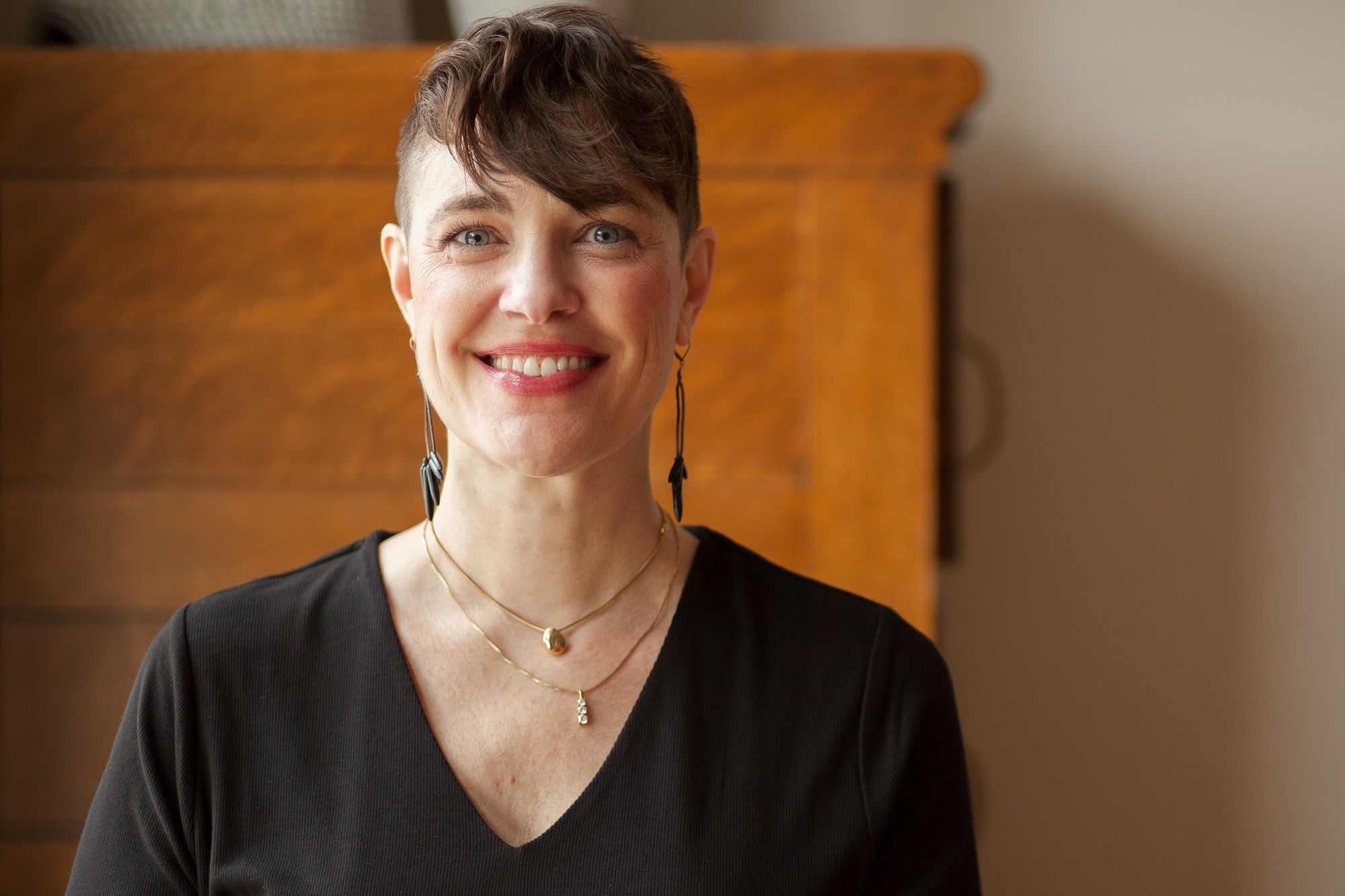
Dicharry is well positioned for the role. As the former director of youth programs for IWP, she brings a deep understanding of the program’s legacy and cultural significance, both locally and globally. Drawing on her experience as director of the Writing and Humanities Program in the Carver College of Medicine and department administrator for cinematic arts in the College of Liberal Arts and Sciences, she says she sees an opportunity to use the guiding principles of interdisciplinarity, humility, curiosity, and empathy to prepare students and writers for fostering civil discourse.
One of her priorities is reimagining the IWP’s home base, the Shambaugh House, a former private residence on North Clinton Street.
Now shared with UI’s Office of Writing and Communication, the Shambaugh House will serve as a gathering space for readings, retreats, and exchange between people from various disciplines and perspectives. “What better way to foster rich conversation and to learn from one another than to establish a place where that can happen?” said Dicharry.
Daniel Khalastchi, executive director of the Office of Writing and Communication, said he is thrilled to be working closely and sharing space with the IWP, calling it a partnership that helps amplify, unify, and expand writing at Iowa.
“With its historical significance on campus and central location in the writing corridor, we are positive that the house will soon become a welcome space for writers, faculty, staff, visitors, and prospective students of all kinds,” said Khalastchi “We look forward to opening our doors this fall."
Several cornerstones of IWP programming will remain. This includes the highly competitive Fall Residency, which will once again bring 25 writers from around the world to the University of Iowa in August. This year, the program is collaborating with campus partners to identify writers who can contribute to multiple university initiatives.
Dicharry shared more about her vision for the IWP and what the university community can expect in the year ahead.

The Shambaugh House at 430 North Clinton Street is home to the Office of Writing and Communication and the International Writing Program. Photo by Justin Torner.
What is your vision for the IWP over the next three to five years? What does that mean in practical terms for the program’s mission and identity?
As ever, the IWP’s mission prioritizes mutual understanding in intercultural community, but the truth is, we live in a deeply divided world and true dialogue across difference and division has become extraordinarily challenging. We’ve seen that in our own programs. That commitment is at the heart of this new era: taking even more seriously our responsibility to foster civil discourse in a world marked by conflict and division and working to cultivate intellectual and creative humility that in turn could facilitate genuine exchange and respectful mutual understanding.
We hope to return to year-round programming, potentially bringing UI faculty and students to other parts of the world, reaching emerging international writers, and creating opportunities that serve our colleagues and graduate students. Achieving that vision will require new funding sources and strong partnerships.
What do you see as the biggest opportunity hidden inside this moment of transition?
Since the IWP’s 59-year funding partnership with the U.S. Department of State ended in 2025, the support we’ve received from university leadership as well as the IWP’s many partners on campus—across disciplines and colleges—as well as the incredibly generous gifts of donors has been extraordinary. It means we are at a moment when we can truly dream big about the future and how the IWP can contribute to the public good. I am genuinely optimistic. This is a moment of tremendous opportunity for us as an organization.

Donor Spotlight: Hugh Culverhouse Jr.
In 2026, Hugh Culverhouse Jr., a Florida attorney, businessman, and philanthropist donated $100,000 to IWP’s programs, bringing his total gifts to the IWP since 2025 to $350,000.
“As an avid reader I believe deeply in the value and importance of literature. The work of the International Writing Program—which had three federal grants terminated last February—not only brings together creative writers from across the globe, it promotes empathy and a way of exploring the world through storytelling. I hope that my gift can inspire others to continue to support the program.”
How do you balance honoring six decades of impact while reimagining the program for a changing world?
The IWP has always been deeply committed to honoring the work of our founders, Paul and Nieh Hualing Engle, and their legacies will always be a central part of our identity. The world has changed in many ways, and we have an obligation as an organization to engage with current conversations in global literature. So much of that simply means being intentional about how we build our communities and the kinds of events we hold, but also the values we embody. I am thrilled to be doing coursework this summer with Sherry Watt, professor in the College of Education, designed for individuals interested in “strengthening their capacity for constructive dialogue across conflict.” We need to listen to our writers and be attentive to their serious concerns so we can build on the Engles’ legacy.
What makes the IWP uniquely positioned to address division and misunderstanding through storytelling right now?
Storytelling remains one of the most powerful ways to foster understanding. When I worked in the Carver College of Medicine as director of the Writing and Humanities Program, I understood our mission to be mitigating dehumanization in medical education and health care through the humanities and creative arts with a focus on narrative. I have found that every single thing I did there—all of the curriculum, lectures, grants, projects—have direct application here at the IWP. How can we understand the complexities of narrative and its relationship to power but also how can we use storytelling to humanize? That is what the IWP can do—not just promote exceptional global literature and offer space to writers to create their work, but also take seriously the implications of the stories we tell in the material world, in people’s lives. How can our creative work make positive contributions?
How will the IWP deepen connections with faculty, staff, students, campus partners, and the broader community in this new era?
The IWP is here for UI faculty, graduate students, and campus partners. Over the past six months, I've spent a great deal of time meeting with colleagues across campus, reintroducing the program, and asking, "What can we do for you? What would you like to see?” Many exciting ideas have emerged from those conversations, and we're already incorporating campus partners—including the Stanley Museum of Art—into our fall programming. I encourage anyone on campus to reach out if they would like to collaborate. I’d love to hear from you.
This fall we will launch new professional development programming that will be for our writers and also available to students. This means bringing editors, agents, and writers to campus to talk about what we call the “business side” of writing—essentially living a creative life but also getting creative work published in the U.S. We are also working to make new opportunities available to graduate students, particularly in the Translation and Spanish Creative Writing MFA programs.
What can audiences expect from the IWP’s Fall Residency?
Our Fall Residency programming will address topics that matter to the writers and the world around us, including art and the digital world, intimacy in storytelling, violence and memory, adaptation, joy amid conflict. The community will be invited to a new panel series that will bring UI faculty together with IWP writers to discuss topics they have identified as important, even urgent, in their thinking and work.
In addition to our longstanding Sunday readings at Prairie Lights and public performances with both the Departments of Dance and the Theatre Arts, we are also introducing Saturday night salons with PorchLight—two IWP writers will be joined by one or two local authors, and they will have a conversation about their work. Our goal is to create as many opportunities as possible for meaningful exchange among writers, students, faculty, and community members.
The writers who come to campus with the IWP are, without exception, extraordinary thinkers and artists. The IWP’s Fall Residency is genuinely a unique and deeply special program—writers from all over the world coming together to the University of Iowa to tell stories and be in conversation about the world. Please join us.

Meet the writers
Visit the International Writing Program's website to learn about the writers who will join the 2026 Fall Residency.