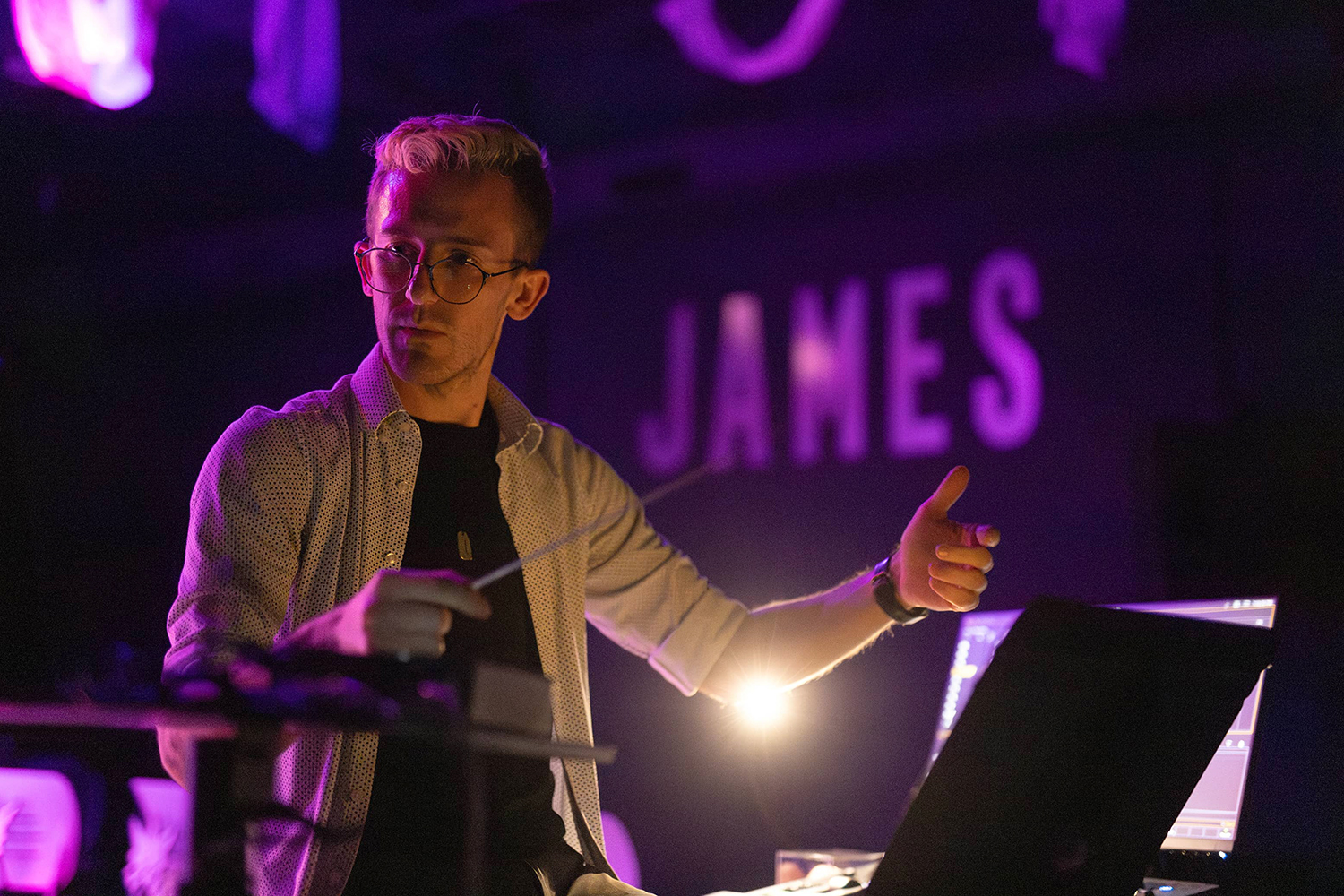
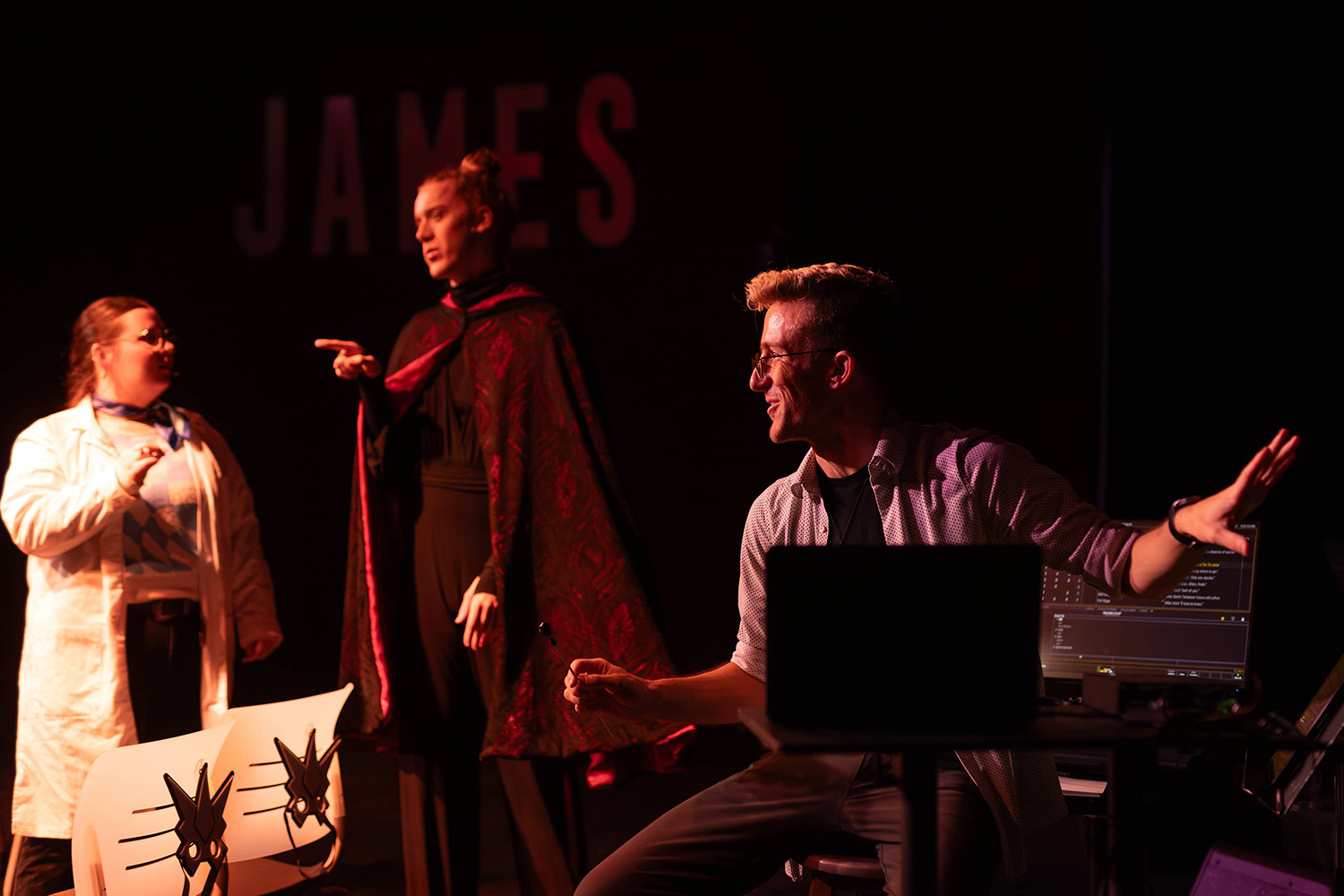
(The curtain rises. Our protagonist, Blake, sits center stage at a piano.)
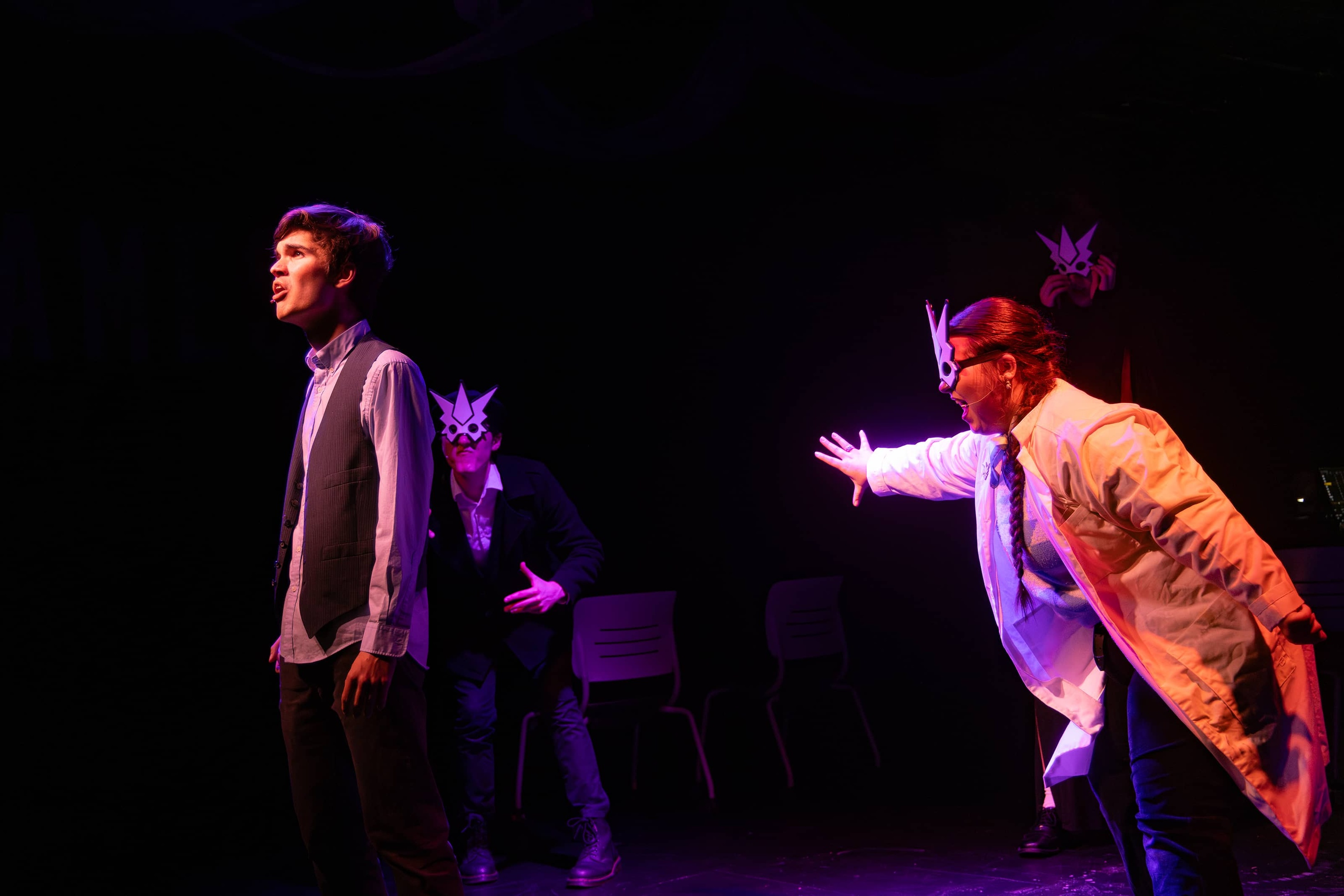
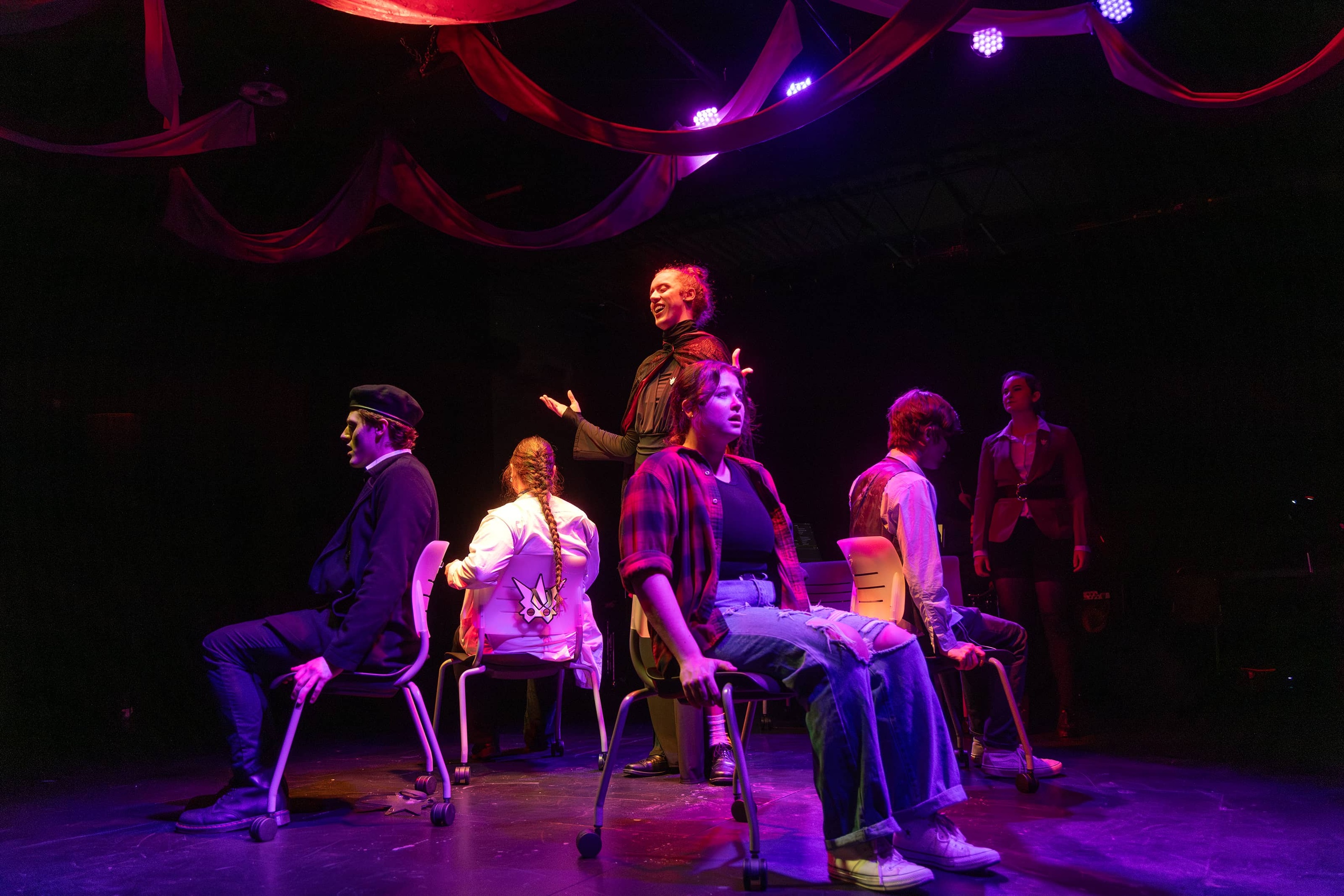
Second-year master’s student Blake Cordell’s thesis isn’t your typical research paper. Instead, he chose to write his own musical. His work, Only a Mask, became a full-scale production that was performed at the James Theater earlier this fall. While this isn’t Cordell’s first musical, it’s his first interdisciplinary collaboration across the arts programs.
Act I: The Origin
(Scene Change: Cordell sits in a classroom in Voxman, poring over sheet music.)
Cordell received both of his undergraduate degrees at Kansas State University, where he studied music composition as well as theater design and playwriting. When a friend asked him to create the score for a play she was directing, it jump-started his interest in sound design.
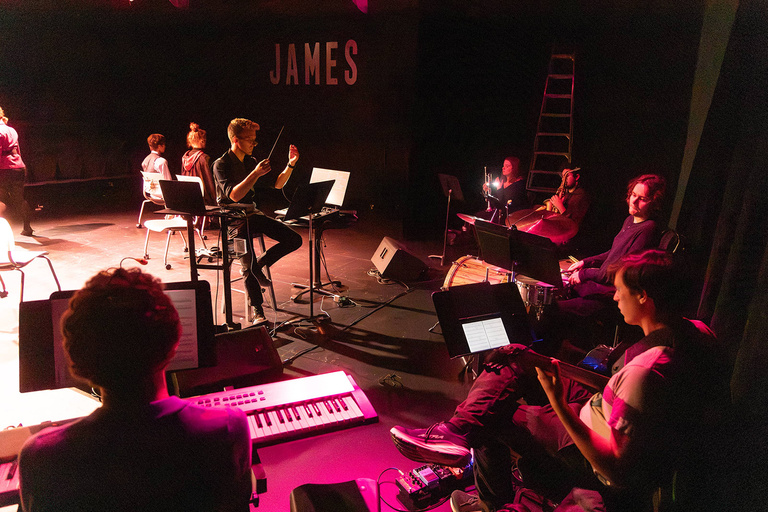
For him, playwriting is the bridge between the two. “My music is narrative. Adding lyrics to it, adding dialogue, adding scenes, adding technical elements, all naturally builds on the skills I have and the way I want to present my music,” he says.
Following his graduation, Cordell moved to Chicago to explore that connection professionally in a theater scene that was known for new developments. He worked in lighting and sound design for a few years, but the COVID-19 pandemic disrupted many of his professional opportunities.
After moving to Iowa for his fiancé’s residency training, Cordell was introduced to the music program and saw it as an opportunity to revisit his early passion and grow his portfolio. Since starting the program, not only has Cordell been able to write in different musical styles, he’s also been able to explore the connection between theater and music again.
While most students finish their degree by composing a string quartet or a sinfonietta, Cordell wanted to use his thesis as yet another opportunity to improve his skills. “This is what I’m good at, and I want to get better at it,” he says.
The idea for Only a Mask had existed for over a decade as an idea shared between Cordell and Francois, a collaboration he found online. The story was originally a video game, but it evolved into a novel, a comic, and a podcast at different points. None of those ideas stuck, but Cordell was able to pull characters and ideas from the worldbuilding to create his musical.
Act II: The Workshop
(Scene Change: Cordell observes a group of students acting, marking notes on a script.)
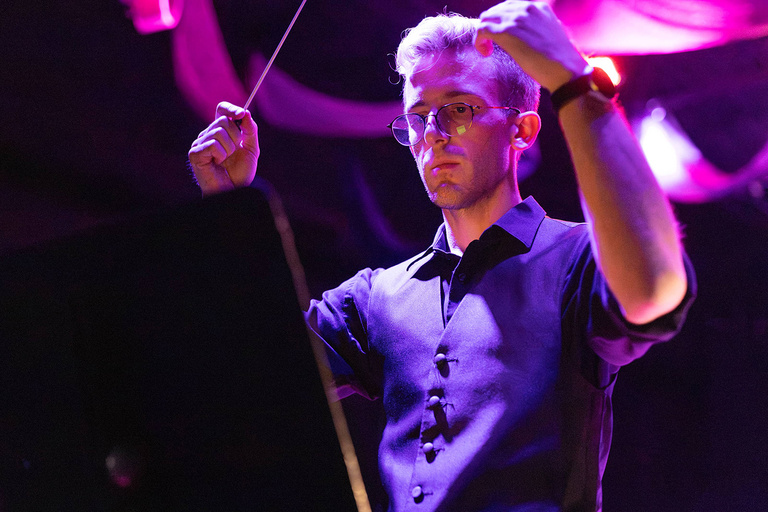
What started initially as a workshop in Cordell’s mind quickly grew to a full-scale production. “My initial thought process behind this was wanting some actors, maybe even add a microphone, with scripts in hand, just singing the music and telling me what works and what doesn’t.”
As the table reads continued and the script went from version 1 to version 3.6, the project blossomed into an opportunity for students across campus. Theatre Arts faculty were looking for ways to broaden their students’ experiences. On the music side, many musicians have to search outside of the school of music for chances to perform in theater. Cordell’s musical took that role.
“I'm getting the chance to bring in a lot of students and give them more opportunities as well, both professionally and developmentally. That's really what's been driving me to finish this project and put in sleepless nights, is how many people are now involved and how many people are getting a lot of really good experience from this program or from this musical,” he says.
In tune with new opportunities, Cordell chose jazz for the musical despite being an underexplored style in theater. Like the central theme of the musical, jazz as a genre has had its identity shaped over the last two centuries, making it a good musical analogy for exploring identity. “What does it mean when you have this iron fist supervillain singing seductive jazz? Can you be threatening with smooth jazz?”
Now the production includes five musicians from the jazz department, a student director from the MFA program, a sound engineer from music, and six undergraduate actors. The idea moved from the classroom to the stage with costumes and scene elements. Working with all of these disciplines has shifted the script, giving Cordell direct feedback on characters, lyrics, and the music.
“I’ve learned a lot about how these different artists approach material, how they are most successful, and what the show means for other people. Hearing them pull out the metaphors, the analogies, and the meanings helped me strengthen those in edits.”
Act III: The Classroom
(Scene Change: Cordell teaching a group of students.)
Only a Mask pushed Cordell to take on new roles, including as a production manager, which he’d vowed never to do. It also inspired a new passion: teaching. Cordell had never pictured himself as a teacher, but his experience as a TA ultimately led him to pursue a teaching certificate.
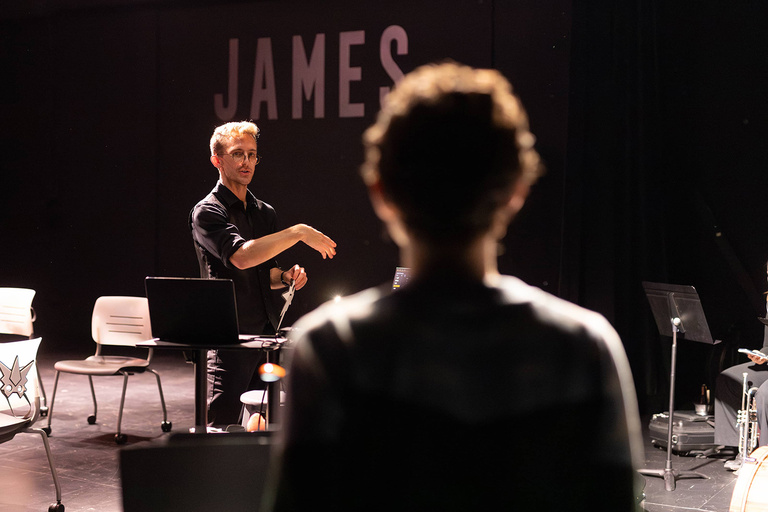
After teaching music theory, regarded as the “math of music,” Cordell realized that he had the skills to get students excited about an often sourly treated topic. Teaching has become another way to combine his interests in pedagogy and practice.
“I can still be writing plays and have opportunities to get those produced. Ultimately, I also want to be reaching and inspiring students to explore those intersections and not treat them as separate fields,” he says.
For now, the curtain has closed on Only a Mask, but Cordell is looking towards his next role, potentially in the playwriting MFA program, where he hopes to continue creating more collaborative experiences for students in the arts.
(Curtain Falls. Applause)