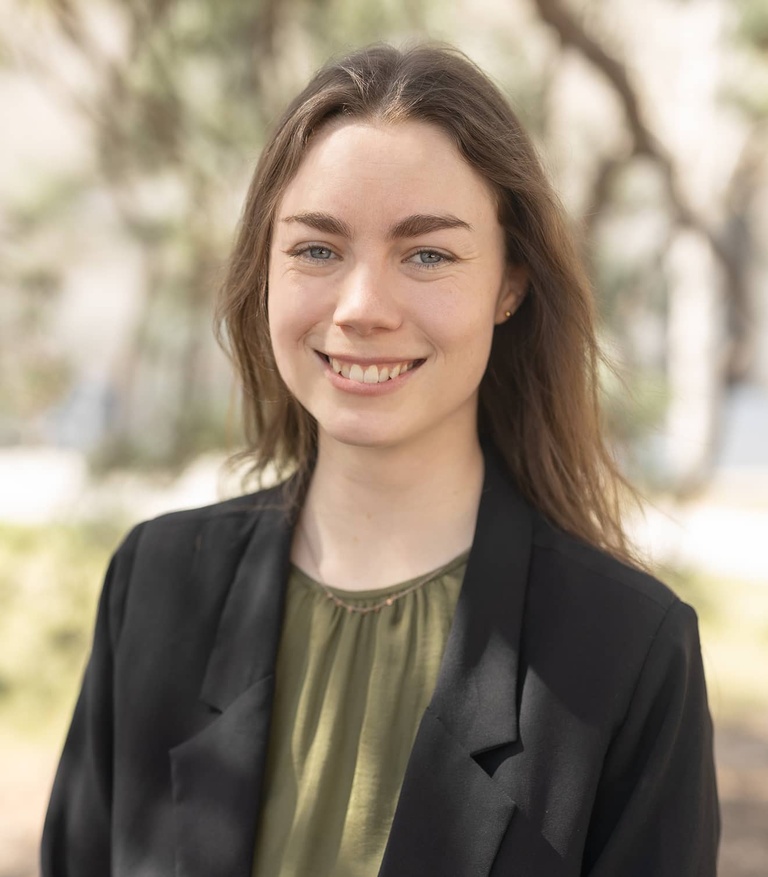
By studying space weather and the Sun–Earth connection, McLennan’s work helps improve our ability to understand and respond to the effects of solar activity on modern technology. She was recently recognized for her high-impact research as a 2026 recipient of the Graduate Research Excellence Award.
What is your program of study?
Doctoral Program in Physics, Astronomy subprogram
Tell us about your path to a graduate program at the University of Iowa.
My interest in physics started in high school while talking with my brother, who told me about mind-blowing topics like dark matter, black holes, and quantum physics. I was fascinated that these phenomena actually exist in the natural world. I loved my physics class, where each problem felt like a puzzle I needed to solve.
I discovered my love for research as an undergraduate while working in a plasma physics lab. I earned a bachelor’s in physics and math at Wheaton College, then studied abroad and completed a master's degree in astrophysics at University of St. Andrews in Scotland. I entered the PhD program at the University of Iowa to pursue my ultimate goal of becoming a researcher in space physics.
Why did you decide to study this field at Iowa?
One of my undergraduate professors told me about the University of Iowa’s legacy of space research and recommended Iowa’s space physics program.
At Iowa, I have the opportunity to study the Sun-Earth connection by observing the aurora with my mentor, Allison Jaynes, associate professor of physics and astronomy. This work aligns with my ultimate motivation to do research that helps people. By studying the near-Earth space environment, we can discover new knowledge that informs satellite technology and improves atmospheric models based on solar events.
Tell us about your research. What accomplishments are you most proud of?
The field of space physics applies plasma physics to everything from the Earth's atmosphere to the edge of the solar system. My research focuses on the aurora and measuring its energetic input into Earth’s atmosphere. Studying auroral activity helps us understand the behavior of energetic charged particles in near‑Earth space. These particles can degrade spacecraft, harm astronauts, disrupt GPS signals, and damage power grids through ground‑induced currents.
I was drawn to this field by the sense of discovery that comes with research, but I also wanted to work in an area of plasma physics with real‑world applications. I study a specific type of energetic aurora, called pulsating aurora, which is an important piece of the puzzle to understand how energy transfers from near-Earth space into our atmosphere. I feel incredibly fortunate to study something so beautiful.
I am proud to be part of multiple international collaborations. Collaborating with scientists from varied backgrounds and perspectives has been deeply enriching. I was also fortunate to receive the NASA FINESST Fellowship in heliophysics, which funded the final three years of my graduate training.
What are your career aspirations?
I hope to pursue a research career in space physics. There are many unanswered questions in the field, and I am particularly interested in studying how auroral activity affects the upper atmosphere. I also hope to mentor and teach in some capacity, to give back to the space physics community and carry on the support that I have received as a student. After graduating, I plan to pursue a postdoctoral position to continue training for a research career.
What advice would you give to others who are considering your field?
For anyone interested in space physics, I recommend reaching out to researchers in the field. I love how collaborative and welcoming this field is.
By contacting a principal investigator, you can learn about ongoing projects and funding opportunities, even if they are not currently recruiting students for their lab. If you are considering graduate school, it is not necessary to have a background in space physics since there are few institutions that teach space physics at an undergraduate level, but it is important to have research experience.
Mentor name and department
Allison Jaynes, associate professor of physics and astronomy, College of Liberal Arts and Sciences
Hometown
Palatine, IL