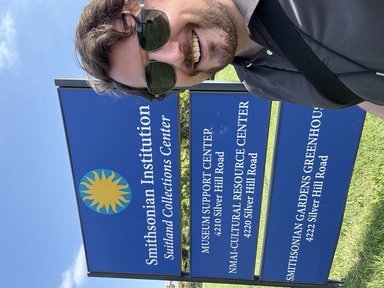
Since his early days in college, Matthew Bowman has felt drawn to Indigenous land issues. Fast forward several years and the now-doctoral candidate finds himself at the Smithsonian Institution in Washington, D.C., searching for answers in art.
Enthralled by landscape paintings in tandem with issues of ecology and America’s fraught history with Indigenous land policies, Bowman earned his master’s in American art at the University of Connecticut and his master’s in Indigenous Studies at the University of Kansas. Now specializing in 19th- and 20th-century American & Native American art in the University of Iowa's Art History Program, Bowman is building a narrative tying art history with ecological issues. His research puts Native land and water rights at the forefront with a focus on the Taos region and modern-day northern New Mexico.
“The most important thing that a lot of scholarship is leaving out is Indigenous relationships and belongings to the landscape and sacred places,” Bowman explains. “That's their political space that they're often trying to get back but also their ecological home where they have kinship with the land.”
A deep dive at the Smithsonian
In his quest to build public knowledge around historic American art, Bowman received the Wyeth Foundation Predoctoral Fellowship at the Smithsonian American Art Museum in 2025 and set out for Washington, D.C. that fall.
“It's been a whirlwind,” he remarks, citing the immense support of his advisor, Eleanor Jones Harvey, curator at The Smithsonian American Art Museum.
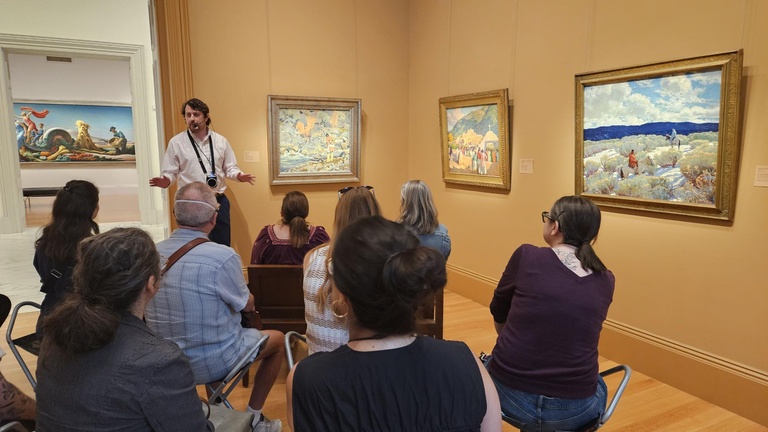
At the onset of his fellowship, Bowman took a volunteer role with Art Bites, in which fellows facilitate a half-hour interactive conversation about one artwork. The public gallery talk was a highlight of his experience in Washington, D.C. In May, the doctoral candidate will also have an opportunity to deliver a formal 20-minute symposium talk discussing a work of art important in his research.
The remainder of Bowman’s time in Washington, D.C. is unstructured, allowing him to explore vast archives such as the collections of the National Museum of Natural History, National Museum of the American Indian, the Archives of American Art, the National Archives, and the Library of Congress—the materials of which Bowman will implement in his dissertation entitled “Contested Lands, Fraught Waters: Images of Taos Pueblo and Its Northern New Mexican Terrain, 1900–1970.”
Alongside his formal analysis of artworks, Bowman is gathering historical documentation from lawyers who represented Taos Puebloan leadership throughout the first half of the 20th century, a tumultuous era in which the Puebloans fought to reclaim their land and water from the U.S. government. Using an assortment of geography and dates, Bowman seeks to identify the rivers and landscapes depicted in historic paintings and photographs by both Indigenous and Euro-American artists.
Bowman considers the experience at the Smithsonian his highest academic achievement, noting the competitiveness and valuable career networking opportunities among its benefits.
A heritage art school
Back in the Midwest, Bowman has much to praise in his overall experience at the University of Iowa’s School of Art, Art History, and Design.
“The program has been fantastic. They provide us the ability to teach our whole tenure as grad students,” he says. Bowman goes on to cite the school’s strong facilities, environment, and heritage, as well as the most important factor in his time at Iowa, his advisor, Dr. Joni Kinsey.
“That's why I came here,” he insists. “She's been my best mentor I've ever had academically, and she's single-handedly improved my style of writing, composition, and argumentation.”
For Bowman, the time spent at the Smithsonian Institution has been a culmination of passion, persistence, and support, and a fitting cap on his research at Iowa.