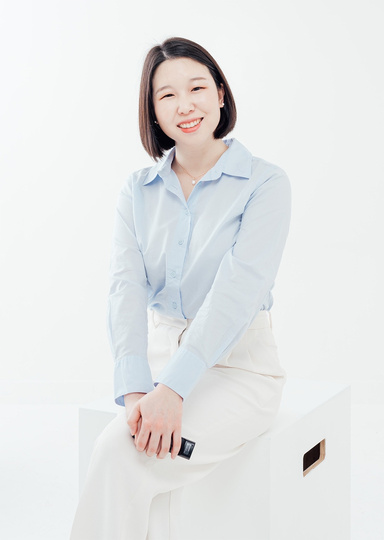
When Jean Hong moved from California to Iowa in 2020, she wanted to answer one question: How do children who are hard of hearing learn to communicate in environments full of competing sounds? That question, rooted in her bilingual upbringing, has carried her from preschool classrooms to cochlear implant clinics, and now into the lab where she studies the intersection of neuroscience and audiology.
Now in her fourth year, Hong is pursuing both her doctor of audiology (AuD) and her PhD in the Department of Communication Sciences and Disorders. Her research focuses broadly on understanding how hearing loss impacts children’s speech and spoken language development.
From curiosity to degree
Hong’s curiosity about language and communication began at home, where she grew up speaking both Korean and English. She completed her undergraduate coursework at UC San Diego, where she majored in cognitive science with a specialization in language and culture. As an undergraduate, Hong worked under Dr. Sarah Creel, studying how preschool‑aged children learn to distinguish different speech sounds. Her time in the Creel lab inspired her to pursue a career in speech-language pathology.
To gain more experience in the field, Hong made a cross-country move after graduation and joined the University of Iowa’s cochlear implant research team in the Department of Otolaryngology as a research assistant. It was the only position she’d applied to where she could work directly with cochlear implant users and learn more about audiology and speech at the same time.
Working with the multidisciplinary team would also give Hong exposure to experts across the field, including audiologists, speech language pathologists, otolaryngologists, cognitive scientists, electrical engineers, and more.
Working with the patients ultimately changed her career trajectory. “I got to see their nervousness before surgery, and then also how much they improved,” she recalls. “How much the cochlear implant device changed their life over time was inspiring. I wanted to know more about the role of an audiologist who is able to make that direct impact on someone’s life.”
Hong enrolled in Iowa’s Doctor of Audiology program in 2022. Recognizing that her research questions required experience in both clinic and lab, she added a PhD in 2025. Pursuing both degrees would open more opportunities for her in the future to do both clinical and research work. “Personally, I think doing both degrees was the best decision of my life,” she says. “Being in the clinic brought a new level of understanding to my research.”
Hong isn’t the first student to do this. The audiology program allows students to add and simultaneously pursue a PhD during their third year. Now in her fourth year, Hong works full-time in a clinical setting. Her externship is at Boys Town National Research Hospital in Omaha, one of the few places where she could do both clinical work and research during her externship. “Boystown is like Disneyland for audiologists,” she laughs. “It was one of the few places where I could gain both clinical and research experience.”
The right fit
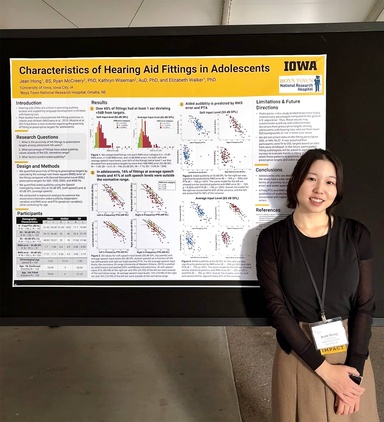
Hong’s research at Boystown examines how hearing aid fittings in children and adolescents impact loudness, sound quality, and background noise. “Our world is surprisingly noisy,” she explains. “Classrooms, traffic, and reverberation all make listening environments difficult. Hearing aids and cochlear implants don’t amplify just speech; they amplify everything.”
For children, this challenge is especially critical. They are in a sensitive period for language development, and unclear input can hinder development. Hong’s current project at Boystown is examining a potential culprit – poorly-fitted hearing aids.
Like glasses, hearing aids also have prescriptions, but research indicates that most are underfit, which negatively impacts speech perception. “It’s like walking around with very blurry glasses,” she explains. “You can hear, but there is not a lot of clarity for speech sounds.”
The study adjusts adolescents’ hearing aids, measuring how they perform in noisy environments and how they rate sound quality. The goal is not only to document the benefits of proper fitting but also to understand why underfitting is so common, which is still unknown. “That’s part of what makes this research so important,” Hong says.
From clinic to lab
Hong’s dissertation is still in development while she finishes her clinical degree at Boystown, but she’s already forming ideas. Her vision is to eventually integrate her current study with her previous experience in neuroimaging. The goal would be to identify the underlying mechanisms for processing speech and background noise and how that is impacted by hearing aid fittings.
“We still don’t fully understand how children and adolescents understand speech and background noise,” Hong says. “Hearing aids and research seem to develop so quickly, but if we’re underfitting their hearing aids the whole time, how much further could we be?”
Examining the long-term effects of underfitted hearing aids could help better inform clinical practices. “By understanding how the maturing brain processes speech in noise, we can provide a foundation for more informed clinical care,” she says.
Hong isn’t listening to the noise of previous research. She’s cutting through to make improvements so that children and adolescents can better understand the world around them.