Article written by: Alayna Becker
Video created/produced by: Cale Stelken
Sometimes, Christopher Merrill saw himself as a poet on the soccer pitch. At least that’s what he hoped he’d become, when he was a teenager growing up in New Jersey. He had a clear seeing heart and the mind of a teammate, who utilizes all the players on the field.
Now, in the final days of his 25-year career as the director of the International Writing Program (IWP) at the University of Iowa, he has proven just how dynamic he can be as a writer and cultural ambassador. Merrill welcomed hundreds of celebrated writers from all over the world to Iowa City for the IWP’s Fall Residency Program. He also has published six books of nonfiction, eight of poetry, translated more than a dozen works, and has been translated himself.
As IWP director, Merrill, while working with the State Department, advocated for international artists, invented diplomatic literary programs, and replied promptly to emails, at all hours, from Myanmar, Iraq, or many other countries.
“So much of (translation) is about trying to find a way to communicate, which means being patient, listening hard, hoping for the best.” -- Christopher Merrill
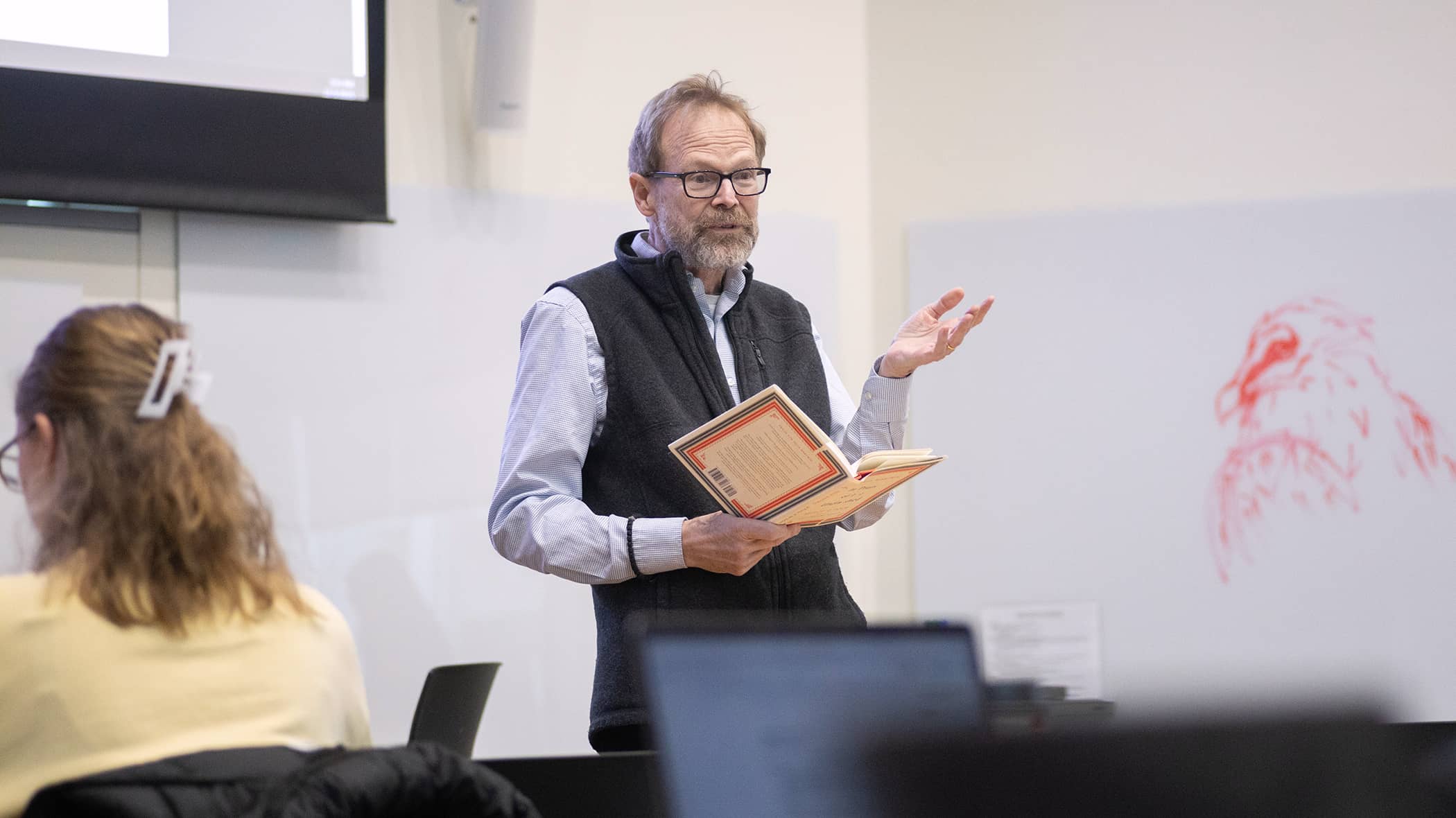
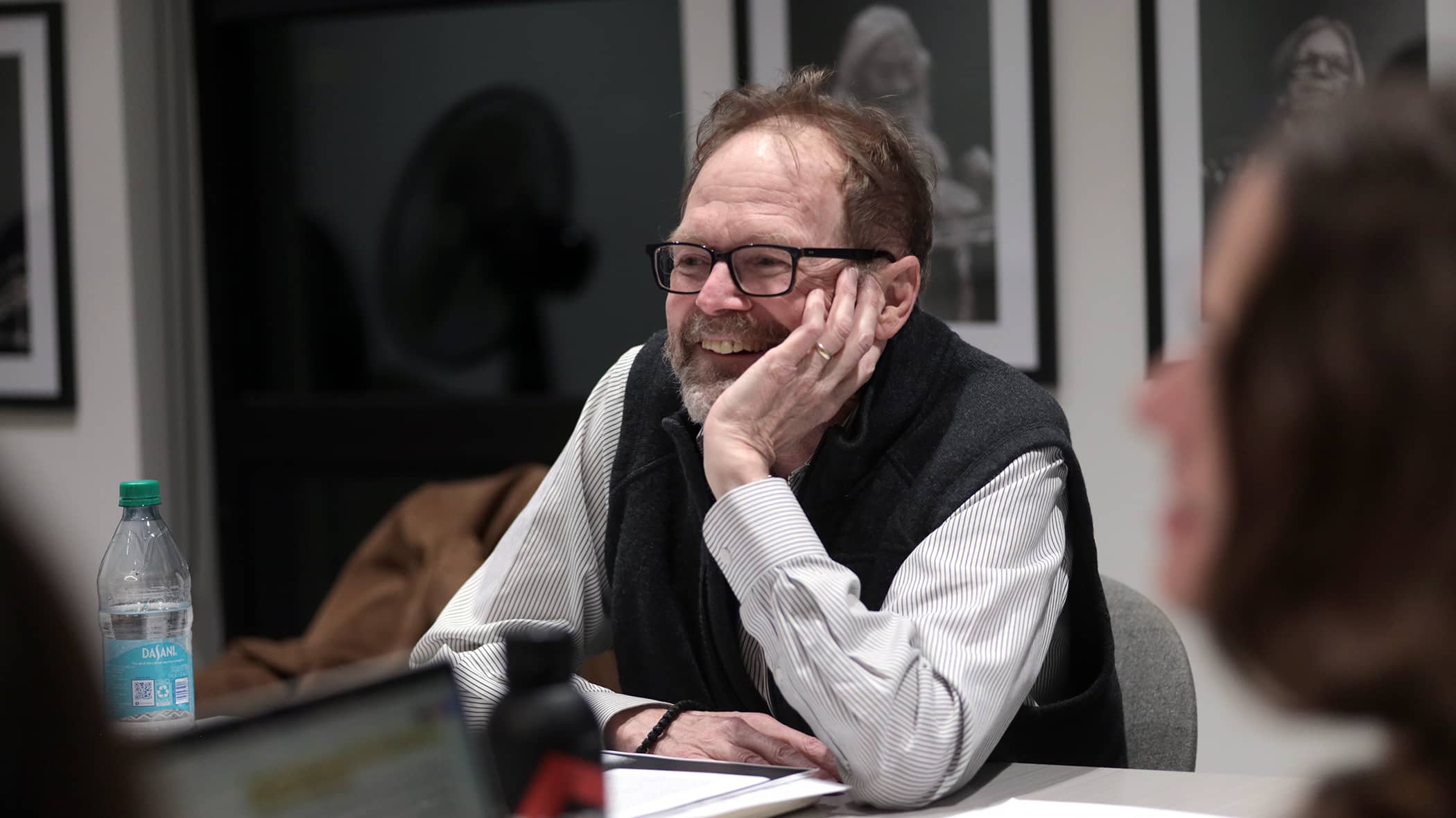
On one of Merrill’s last Tuesdays in the Shambaugh House, his books already finding their way into cardboard boxes to be shipped to New Mexico, where Merrill’s wife awaits him for the beginning of their next chapter in retirement, Merrill says, “What you learn in training to be a soccer player is how important it is to keep focusing, keep trying, expecting to fail a great deal, which is the lesson that you learn in writing poems and stories. Usually, things are not going to work out, but you keep at them.”
A colleague and friend, Professor Ed Folsom, describes Merrill as soft-spoken, but his ambitions for the program were high.
IWP reaches new heights
When Merrill took the reins in 2000, this spirit of focus and struggle grew the IWP from a program in collapse to a program that has helped define the legacy of the University of Iowa as the Writing University. More broadly, he was the one to write to UNESCO and explore the steps of designating Iowa City as a UNESCO City of Literature.
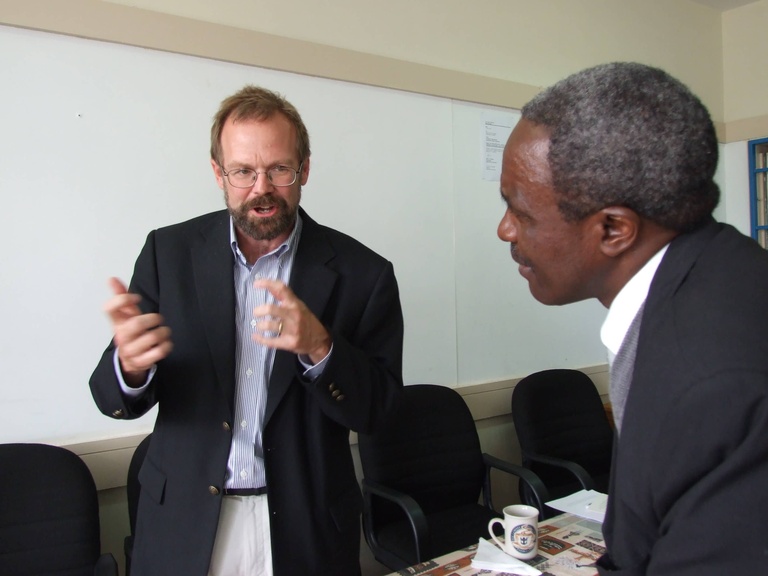
Natasa Durovicova, a long-time IWP colleague who retired last year, says, “He had this great combination of being a poet, which was really at the heart of the enterprise, but at the same time his journalistic background and his war journalism in particular made him somebody who's just very expansive and for whom the international was as important.”
Plus, Durovicova says Merrill possessed the great organizational mind needed to operate a program of this magnitude. He was always ready with new ideas, ways to pivot, and people with which to collaborate.
This flexibility and ability to make do led Merrill to help the IWP weather changing administrations in Washington, D.C. and the State of Iowa, and to make the most of every possibility when the State Department was investing in literary diplomacy.
During the Obama administration, Merrill and Folsom launched the WhitmanWeb, featuring Walt Whitman’s poem “Song of Myself” in nine languages: English, Chinese, French, German, Persian, Portuguese, Russian , Spanish, and Ukrainian. Translations from Arabic, Malay, Polish, Romanian, Khmer, Kurdish, and Filipino followed in 2013 and 2014, with two versions of translation into the Turkish in 2021. The idea behind the project was to have a conversation, across languages, borders, and time zones, about the multiple meanings of this foundational text of American literature.
Literary translation is central to the IWP. It pulls from the same skill set of teamwork in soccer and the deep attention of poetry.
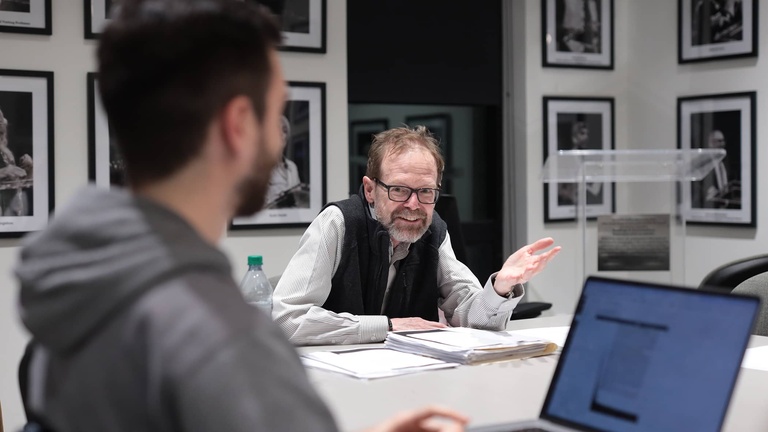
“So much of (translation) is about trying to find a way to communicate, which means being patient, listening hard, hoping for the best.” Merrill says.
Listening, and being present to what is requires its own practice.
"You must be patient," Merrill says. "Then, for me, it means trying to overcome whatever preconceived ideas I might have about a subject, or somebody I'm meeting. Then I try to hear what's going on, not just in what they might say to me or what the text might say to me, but to try to listen harder for what I might not be able to hear.”
IWP undergoes transition
The IWP is in another great transition. In February, the U.S. Department of State notified Merrill that three grants totaling more than $950,000 through the department’s Bureau of Educational and Cultural Affairs were being terminated. The grants no longer aligned with “agency priorities and national interest,” according to the State Department. This means the IWP has reduced its programming and is looking for a new path forward.
Merrill says he believes in his successor, long-time, IWP employee Cate Dicharry and her ability to forge a road ahead.
“I’m afraid she's going to have to keep her hat out.” Merrill says, “But Cate worked here on and off for quite some time. She knows what the IWP is all about, and I have every confidence that she'll take it to its next place.”
As for Merrill, retirement is more of a concept. In Santa Fe, NM, he will work on his next book, due to editors next fall. After that, he says, “I just hope to keep my eyes and ears open.”
Additional videos