The LMNA gene is one of scientists’ most difficult genetic codes to crack.
Mutations in the gene can cause 14 different diseases, and more than 500 pathogenic mutations have been identified, which result in different disease presentations and progressions from person to person. Because of the nature of the mutations, gene replacement is not an option for patients, and other treatments have been notoriously difficult to develop.
With such a need for developing treatments for these mutations, Nathan Mohar went to work during his time as a doctoral student in the Interdisciplinary Graduate Program in Genetics at the University of Iowa.

Mohar, a native of Germantown, Wisconsin, conducted his research on muscular dystrophy caused by mutations in LMNA gene. He set out to solve the mystery of why individuals with the same muscular dystrophy causing mutation can have quite different disease symptoms. Some individuals develop severe muscle and cardiac problems, while others with the same mutation show minor or no disease symptoms.
“There’s no clear genotype-phenotype correlation between individual mutations and disease caused,” says Mohar, who earned his PhD from Iowa in April 2026.
Mohar worked closely with two families with some siblings with severe disease and others with no symptoms. This provided an opportunity to identify genetic modifier genes. Using whole genome sequencing followed by functional studies in a model organism, he identified the first modifier gene called SMAD7. DNA sequence changes in the SMAD7 gene influence the severity of muscular dystrophy caused by the mutation in the LMNA gene.
“The point of my research was to find those genetic modifiers that can cause more severe versus less severe muscular dystrophy,” Mohar says. “If you know what is causing people to be more severe, you can then target that (mutation) to make people with more severe symptoms less symptomatic. That would not be a complete cure, but it would improve quality of life.”
Nathan tested mutations in the SMAD7 gene in fruit flies and showed that the mutation made muscle deficits more severe.
This finding was published in Science Advances, a journal that has a five-year impact factor of 14.8. A journal’s impact factor measures how often an article in an academic journal is cited during a specific year. This impact factor places a journal among the top tier of academic publications globally.
Mohar’s work also impressed the scientific community. He was among the only student trainees selected to give an oral presentation at the 2024 and 2026 Muscular Dystrophy Clinical and Scientific Conferences.
“Nathan’s research is at the forefront of the genetics of human disease. His studies have informed on disease mechanisms and identified potential treatments,” says Lori Wallrath, Mohar’s advisor, professor, and director of the Interdisciplinary Genetics Program. “Patients will receive a more informed diagnosis, and physicians will be able to provide improved care.
“Nathan has brought together researchers and clinicians and used his superior scientific knowledge and skills to train others and make an impact on the University of Iowa’s scientific community.”
The Graduate College honored Mohar with the 2026 Rex Montgomery Dissertation Prize for his thesis titled, “Genetic modifiers and treatments for striated muscle laminopathies.” This award recognizes the most meritorious dissertation by a doctoral student conducting research in prevention of disease and/or the translation of research into clinical practice.
Teamwork leads to big discovery
Mohar cautions that his thesis is more of a proof of concept and his findings need further testing. However, that does not diminish the impact of his groundbreaking work.
“(Professor Wallrath) and I were the first to identify any of these additional genetic mutations that can influence phenotype for this disease. Many people have tried but we were the first to identify a specific gene in which mutations can influence phenotypes of individuals with LMNA muscular dystrophy.”
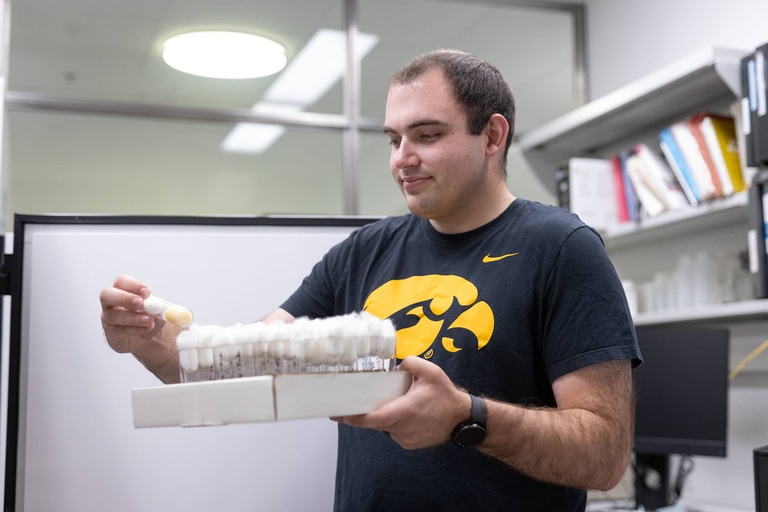
Many components came together to contribute to this finding.
“Luck definitely plays a factor, but we also had highly motivated people,” Mohar says.
A family diagnosed with a rare form of muscular dystrophy called Emery Dreifuss provided their clinical history and patient samples to help push the work forward.
“Honestly, it's luck in identifying these families that have this ideal genetic situation. You have a very small number of individuals who are all siblings, so they can only have so many genetic differences,” Mohar says.
Mohar also credits collaborator Benjamin Darbro for helping with the discovery. Darbro, who serves as associate professor of pediatrics and associate director of the Iowa Institute of Human Genetics, led the genome sequencing and variant identification for the project.
Professor Wallrath played a key role in her student’s development as a top-flight scientist. Mohar was given freedom as a graduate student to direct the project entirely on his own.
“Lori really sees the value in mentorship and training, while fostering the next generation of scientists in combination with running her lab,” Mohar says. “She could not have provided me a better environment to work in. It was a tremendous experience.”
Mohar currently is an advisor in the Rotational Development Program at Eli Lilly and Company in Indianapolis, Ind.