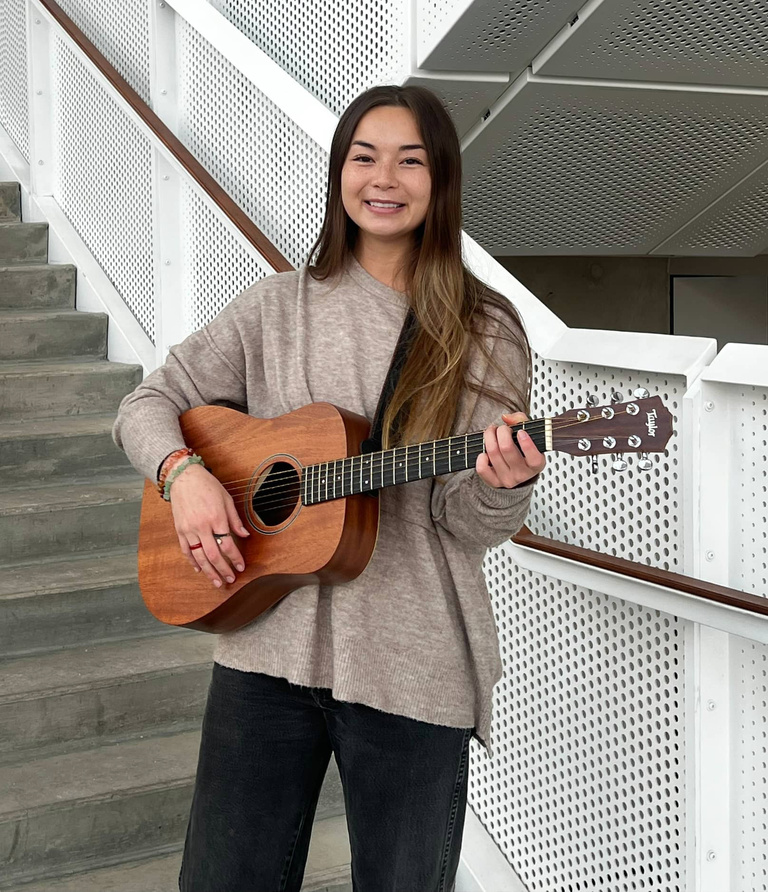
Jayda Hunstad (MA ‘26) knows a lot about pain. There are the pain studies in her Masters of Music Therapy Program where they learn about chronic and neurological pains, those that ache, sizzle, and wrench. Then there’s pain from an injury, or post-surgical pain.
Hunstad knows that kind of pain intimately– she spent her junior year of high school preparing for invasive spinal fusion surgery for idiopathic scoliosis, which is one of the most painful surgeries experienced by adolescents, according to University of Iowa Professor Kirsten Nelson, MA, MT-BC. It took her entire senior year to recover from the surgery,
Hunstad also knows a lot about music. She’s played piano since she was in the second grade, while also playing guitar and singing.
A performance studies major from Northern State University in Aberdeen, South Dakota, Hunstad found the University of Iowa while trying to determine her next step, “I knew teaching [music] wasn’t for me,” she says, “And I didn’t think I was going to be on Broadway.,”
She wondered, what else is there?
She hadn’t even known music therapy was a discipline when she clicked the University of Iowa Music Therapy homepage. She felt something click, scrolling the page, reading the description. As she spoke with professors on the phone, Hunstand was impressed with how helpful they were. This really could be the perfect path, she thought, for her music performance background and her desire to help others.
That same faculty whohelped her to find her path to Iowa led Hunstad to a breakthrough. Kirsten Nelson, professor of instruction in music therapy, presented her research to music therapy students during her work with adolescents receiving spinal fusion surgery. The same surgery Hunstad had in her teenage years. Jayda couldn’t believe it. She knew just what that was like. Nelson’s research focuses on utilizing music-assisted relaxation with controlled breathing and imagery, which demonstrates a promising intervention for reducing pain and anxiety for these patients.
“Music was a big part of my recovery, and I realized I was doing music therapy naturally on my own,” says Hunstad who had a lightbulb moment that altered her perspective on music and the power it holds, “Music simultaneously stimulates multiple parts of our brain, and no other medium or therapy can do that.”
Music therapy is the clinical and evidence-based use of music interventions to support physical, emotional, cognitive, and social well-being. The field draws from psychology, neuroscience, medicine, and music education. Research shows that music therapy can help reduce stress and anxiety, improve mood, enhance communication skills, support motor rehabilitation, and aid in managing symptoms of conditions such as autism spectrum disorder, dementia, chronic pain, and mental health disorders.
Music therapy isn’t just about pain. As part of her practicum, Hunstad leads community group therapy sessions. Last semester, she was in a special education classroom in North Liberty.
“It’s like secret therapy,” she says, describing the way playing music together is inherently social therapy, with impulse control are baked in.
Professor Kristen Nelson speaks to Hunstad’s work.
“Jayda is a dedicated student whose creativity and love of people shines in her clinical work,” Nelson says.
Hunstad’s research capstone project is advancing the work of Nelson and utilizes her preexisting knowledge of the specific pain of this type of surgery. In her words, her capstone project focuses on post-operative pain management for adolescents undergoing spinal fusion surgery.
“I'm aiming to explore the impact (how practical, useful, and effective) of utilizing music therapy techniques at home during the post-op recovery and the influences on pain management,” Hunstad says. “I plan to achieve this through developing two easy-to-follow music therapy videos that will be shared with patients and their families during the pre-operative visit for them to utilize and implement during home recovery.”
There was no way for Hunstad to know her passion could meet her pain. But here she is, years after her surgery, advancing the discipline by translating her journey into research that strengthens patient care and recovery outcomes.