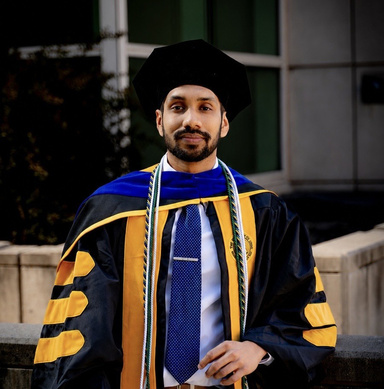
Harindu Rajapaksha, who recently completed his doctorate in chemistry, is the winner of the Graduate College’s 2026 D.C. Spriestersbach Dissertation Prize in the category of Mathematics, Physical Sciences, and Engineering. His research focuses on better understanding the behavior and stability of elements found in nuclear waste in an effort to improve its management.
After graduating this spring, he joined the Idaho National Laboratory as a Glenn T. Seaborg Distinguished Postdoctoral Research Associate. He answered a few questions about his journey at Iowa and his current work in Idaho.
What is the focus of your research?
My research focuses on understanding the chemistry of uranium and neptunium, two elements found in used nuclear fuel. Although nuclear energy is one of the cleanest ways to produce electricity, managing nuclear waste safely remains a major challenge.
I study how these materials change when they are exposed to radiation, water, and different chemical environments. By combining laboratory experiments with computer modeling, I investigate how these changes affect their stability and behavior over time.
The goal of my research is to improve our understanding of nuclear waste so we can develop safer ways to store, recycle, and manage it. Ultimately, I hope this work contributes to making nuclear energy a safer and more sustainable source of clean energy.
What inspired you to get into this field of research?
When I was growing up in Sri Lanka, I remember seeing large nuclear power plants on television and thinking they were incredible feats of engineering. As I learned more about science, I also learned about the challenges that come with nuclear energy, especially how to safely manage nuclear waste.
That curiosity stayed with me. Today, as the world looks for reliable sources of clean energy, I believe nuclear power has an important role to play. I wanted to contribute to solving one of its biggest scientific challenges, and that’s what led me to this field.
Along the way, I was fortunate to be mentored by outstanding scientists who encouraged my curiosity and helped me develop as a researcher.
Why did you choose Iowa for graduate education?
As an international student, I wanted a university that combined excellent research opportunities with a welcoming and supportive community. My wife and I were both pursuing PhD degrees, so finding a place where international students felt accepted and supported was especially important to us.
The University of Iowa offered exactly that. From the beginning, I found faculty members who invested in my success, a collaborative research environment, and a campus where we felt at home. Those experiences made Iowa the right place for both our academic and personal journeys.
What are your aspirations for employment and/or research in this field? Where do you hope this field will take you?
This summer, I joined Idaho National Laboratory as a Glenn T. Seaborg Distinguished Fellow. My goal is to continue researching the chemistry of nuclear materials and develop new ways to improve nuclear fuel recycling and waste management.
In the long term, I hope to become independent scientist leading research that addresses important energy challenges. I want my work to help make nuclear energy safer, more efficient, and more sustainable while also training the next generation of scientists.
What accomplishments are you most proud of?
Professionally, I’m proud of the research I’ve been able to publish and the opportunity to continue my career at Idaho National Laboratory.
Personally, however, my greatest accomplishment is that my wife and I completed our doctorates while raising our young son. Balancing research and family life was challenging, but it taught us resilience, teamwork, and perspective. Looking back, graduating together as a family makes the achievement even more meaningful.
How has the University of Iowa supported you in your academic and/or personal goals?
The University of Iowa gave me opportunities that extended far beyond the classroom. My advisors trusted me to pursue ambitious research projects, collaborate with national laboratories, and present my work at conferences around the world.
Personally, the university community also helped my family feel welcome during an important chapter of our lives. The friendships, mentorship, and support we received made Iowa feel like home and allowed me to grow not only as a scientist but also as a husband, father, and mentor.
Mentors
Tori Z. Forbes, professor, Department of Civil and Environmental Engineering, College of Engineering
Sara. E Mason, associate professor, Applied Mathematical & Computational Sciences, Department of Chemistry, College of Liberal Arts and Sciences
Hometown
Badulla, Sri Lanka