
Audiences tend to follow dancers: their movements, gestures, and interactions. A dancer moves at a particular distance from another person, within a particular space, surrounded by objects and other elements that can affect what an audience sees and feels.
Yoshito Sakuraba spent part of his summer thinking about those surroundings.
Sakuraba, an MFA student in dance at the University of Iowa, received a Graduate College MFA Summer Fellowship to focus on his creative research.
“My research examined how space, perception, and environmental conditions can influence an audience's perception, I am no longer thinking only about choreographing bodies; I am increasingly interested in choreographing space and the conditions through which meaning emerges.”
Choreographing space
Movement takes shape within its surroundings. Put two performers close together and one relationship emerges. Increase the distance between them and the same movements may be interpreted differently. An object can divide a space or draw attention toward one part of it. Where an audience sits determines what is visible and from what angle.
Sakuraba's interest in these relationships comes after more than a decade of professional work as a choreographer. He founded the contemporary dance company Abarukas in New York in 2012, and his choreography has been presented in the United States and internationally.
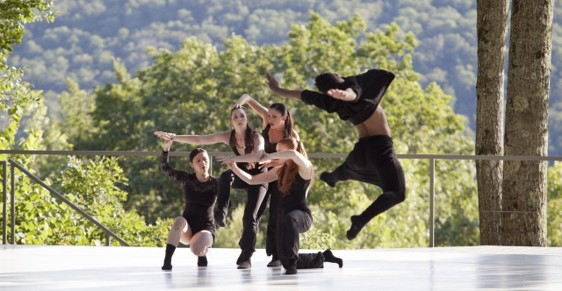
At Iowa, he is examining that established practice again.
The fellowship, Sakuraba says, “provided me with an opportunity to reflect on my current practice, recalibrate its direction, and discover a new entry point for exploring dance.”
Sakuraba's recent work at Iowa has already involved elements beyond the dancers themselves. His piece She is Placed, Then Continues, presented during the Department of Dance's 2026 Graduate Concert, incorporated strobe lighting, haze, sound, and a moveable lighting device. The lighting unit could move into an audience member's line of sight, making the conditions of watching part of the experience.
His summer research moved into questions about how those conditions influence perception.
Coming to Iowa
Sakuraba was already working professionally when he decided to pursue an MFA at Iowa.
“I decided to study the field at the University of Iowa for the diversity of courses, the hybrid nature of the program, the collaborative environment, and the faculty. Iowa City's culture, landscape, and community were also appealing.”
His time at Iowa has placed his professional practice within a setting where coursework and creative research can exist alongside one another. The summer fellowship removed one of those elements temporarily: the demands of the regular academic semester.
A summer focused on the work
“This summer fellowship was crucial for me because I could purely focus on my research without external distractions and pressure from other courses,” Sakuraba said.
For Sakuraba, that time became an opportunity to reconsider the direction of his choreography and step back from the demands of producing work within an established practice.
“It's especially useful for people who struggle to find dedicated time for research during busy semesters,” he said.
Sakuraba's description of the summer points toward an expanded view of choreography, one in which the dancer remains part of a larger environment and the choreographer pays closer attention to the conditions through which an audience encounters movement.
His shift toward “choreographing space” also changes what can count as choreographic material. Bodies remain visible. The air between them, shaped by distance, light and sound, begins to feel like part of the dance.