
August 19, 2026
Written by: Cale Stelken
For many graduate students and postdoctoral researchers, the path beyond academia is filled with possibility—but also uncertainty. While students are highly trained in research, teaching, and problem-solving, many still seek practical job-hunting skills to prepare them to find employment outside the university setting.
The University of Iowa Graduate College’s Career Ladder Program was created to help bridge that gap.
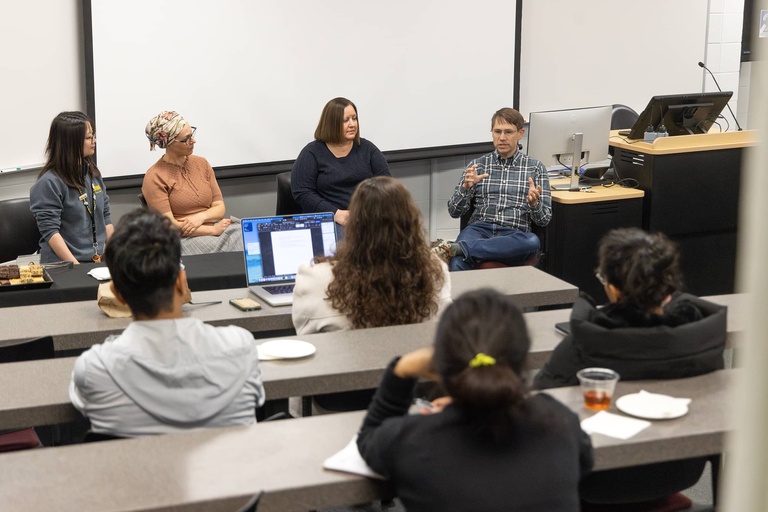
Offered through the Grad Success Center, Career Ladder supports graduate students and postdoctoral researchers as they explore career options beyond the classroom and laboratory, while also helping them build the practical skills needed to pursue job opportunities with confidence.
“Our goal for Career Ladder is to show students that they have options,” says Meng Xiao, PhD, graduate career counselor in the Grad Success Center.
Shreyashree Sarkar, a fifth-year doctoral student in the Molecular Medicine Program, enrolled in Career Ladder in fall 2025 and spring 2026. At the time, she was uncertain about her next steps after completing her PhD and wanted help to understand both her options and how to position herself for them.
“I didn’t have a clear picture of what my options were, what I would be best suited for as an international student, and how to approach those positions,” Sarkar says.
Through the program, Sarkar worked on her resume and CV, explored career possibilities, and gained confidence through interactive exercises and practice.
“Overall, the goal of joining this program was simply to bridge the gap between getting a degree and landing a job with the skills that no curriculum teaches. Meng taught us exactly all of those and more.”
Paths beyond academia
According to Xiao, while faculty roles have historically been viewed as the default next step for many doctoral students and postdocs, an increasing number are now exploring careers in industry, government, nonprofits, and other sectors. Along with this, they are often considering factors such as location, salary, family alignment, and work-life balance.
That transition, however, is not always straightforward.
Many graduate students and postdocs have spent years moving through academic systems with limited exposure to non-academic hiring practices. As a result, tasks such as networking, interpreting job descriptions, interviewing with employers, or negotiating salary can feel unfamiliar and intimidating.
“With many of our postdocs, they go directly from bachelor’s to master’s to PhD to postdoc,” Xiao cites.
Career Ladder was designed to help participants step beyond that bubble.
A comprehensive model

Originally launched virtually in 2020 and inspired by a similar program at Stony Brook University, the program has since evolved into a staff-led, cohort-based experience at Iowa. After joining the Graduate College in 2024, Xiao reimagined Career Ladder with a stronger focus on structure, interactivity, and practical application. She first redeveloped the program for doctoral students and has since facilitated multiple cohorts for doctoral students and postdoctoral researchers.
The program is built around what Xiao calls a “3D model”:
Design - exploring career paths and clarifying goals
Develop - building materials such as resumes, CVs, professional statements, and LinkedIn profiles
Deliver - preparing for interviews and salary negotiation
This structure helps participants move from reflection to preparation to action. In addition to workshop sessions, Career Ladder offers one-on-one support and incorporates guest speakers who can provide employer and industry perspectives.
Xiao often invites human resources professionals to answer questions about the hiring process and explain how applications are reviewed outside academia. She also brings in professionals such as bench scientists, science managers, and science writers to help participants better understand career pathways and hiring expectations.
The program is especially valuable for international students and scholars, who often face additional layers of complexity related to visas, U.S. hiring norms, and long-term career planning. Xiao’s own experience as an international student helps her understand and address many of those concerns in ways that resonate with participants.
Assistant Dean Jennifer Teitle, PhD, who oversees the Grad Success Center, says the program’s growth reflects both student need and Xiao’s facilitation style.
“She is so incredibly relatable to students,” Teitle says. “Her humor, her type of support combined with her expertise—she combines all of these pieces together. Doctoral students are opening the newspaper and seeing the headlines. It’s a scary time to be looking for a job, but because of the approach that Meng takes with this conversation, it still feels doable, light, and secure.”

Career support in action
The support and momentum the Career Ladder Program offers has proven invaluable for postdoctoral researcher Kelsey Schwartz. After earning her doctorate in Health and Human Physiology from Iowa in 2024, she knew she wanted to pursue industry roles but felt unsure how to navigate the search.
With Xiao’s guidance, Schwartz learned how to target positions more strategically, strengthen her resume for industry applications, and use LinkedIn more effectively for networking and visibility.
“She helped me realize that I was looking at positions I was overqualified for and that I needed to aim higher,” Schwartz says. “Now I have a resume I am proud of and feel confident in adapting to different job postings.”
As Schwartz refined her goals, she also decided she wanted to move overseas, adding another layer of complexity involving visas and international job searching. Xiao connected her with a former Career Ladder participant who had recently relocated to Europe, helping Schwartz navigate the transition.
“With Meng’s support at every step, from interview prep to negotiating with confidence, I accepted a position in the Netherlands and will be moving there with my partner and pets in September. I have recommended this program to so many people, and I cannot overstate how much Meng’s knowledge and generosity made it possible.”
For Xiao, those outcomes reflect the larger purpose of the program.
“There is so much talent in our graduate and postdoctoral community,” she says. “Sometimes people do not need more potential - they need structure, encouragement, and practical tools. That is what Career Ladder is here to provide.”